
AI agents in production: from POC to a system you run
What changes between an AI agent demo and a production system: data, security, evaluation, ownership, cost and adoption. A practical guide.
Short answer: a proof of concept shows that an AI agent can work on clean sample data. A production system must keep working on real data, under real security rules, with an owner, a budget and users who adopt it. Plan six things from day one: data, security, evaluation, ownership, cost and adoption.
What is an AI agent, in plain words?
Definition: AI agent. Software that uses an AI model to pursue a goal by choosing and using tools (a mailbox, a document store, a CRM) rather than only answering a question.
Think of a capable new colleague. The model is their brain, the tools are their keys, and your rules decide which doors they may open. Most failures come from the keys and the rules, not from the brain.
The four stages: POC, pilot, production, run
| Stage | Question it answers | Who owns it |
|---|---|---|
| POC | Can it work at all? | Project team |
| Pilot | Does it help real users on real data? | Business sponsor and tech lead |
| Production | Can we depend on it? | A named product owner |
| Run | Can we afford and improve it over time? | Owner and operations |
Many projects stop between the POC and the pilot because nobody planned for the next column.
What changes at each stage
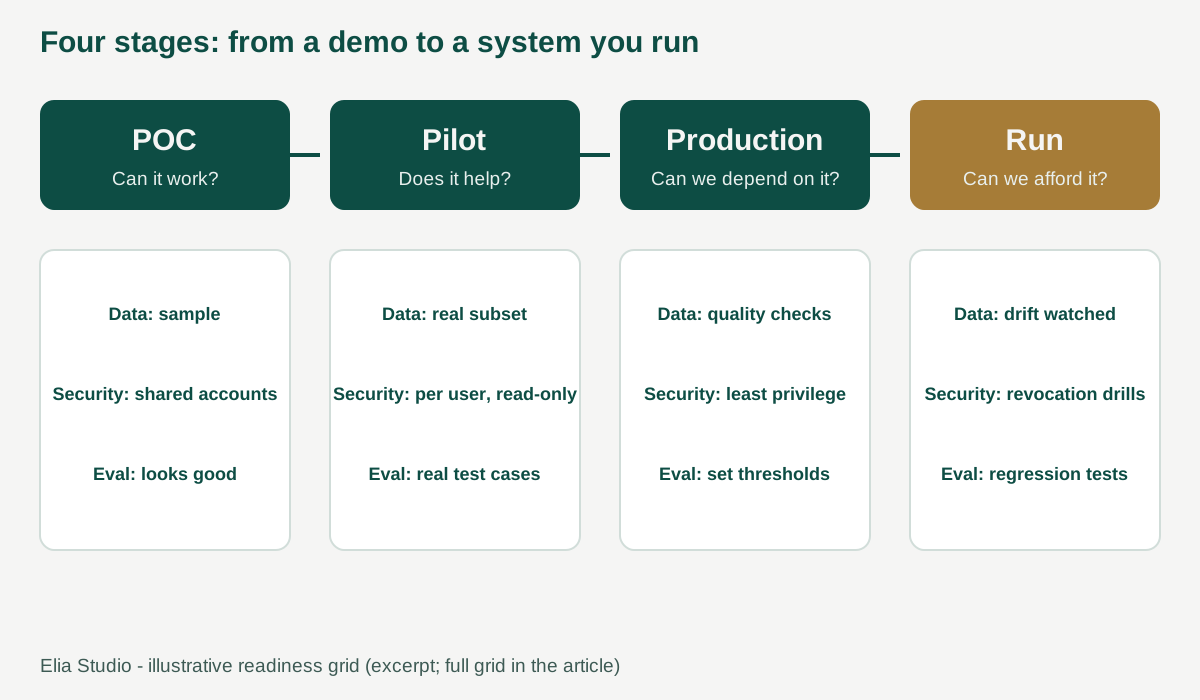
A practical readiness grid. Use it to check what is missing before you move to the next stage.
| Dimension | POC | Pilot | Production | Run |
|---|---|---|---|---|
| Data | Sample, cleaned by hand | Real subset | Real flows, quality checks | Drift monitored |
| Security | Shared test accounts | Per-user access, read-only | Least privilege, audit, key management | Reviews, revocation drills |
| Evaluation | “It looks good” | Test set of real cases | Measured quality thresholds | Continuous regression tests |
| Ownership | Whoever built it | Sponsor named | Product owner and support path | On-call and roadmap |
| Cost | Ignored | Estimated | Budget per task, alerts | Cost per outcome tracked |
| Adoption | Demo audience | A few champions | Training and usage policy | Usage and satisfaction KPIs |
The control layer every agent needs
Between the agent and your tools, put a layer you control. It applies five habits:
- Least privilege: the smallest permissions that do the job.
- Read first: start read-only, and widen scope only after proof.
- Human confirmation for writes: one approval, for one exact action.
- Per-person credentials: never shared, encrypted, out of the model's reach.
- Audit without content: record who did what and when, not a copy of the data.
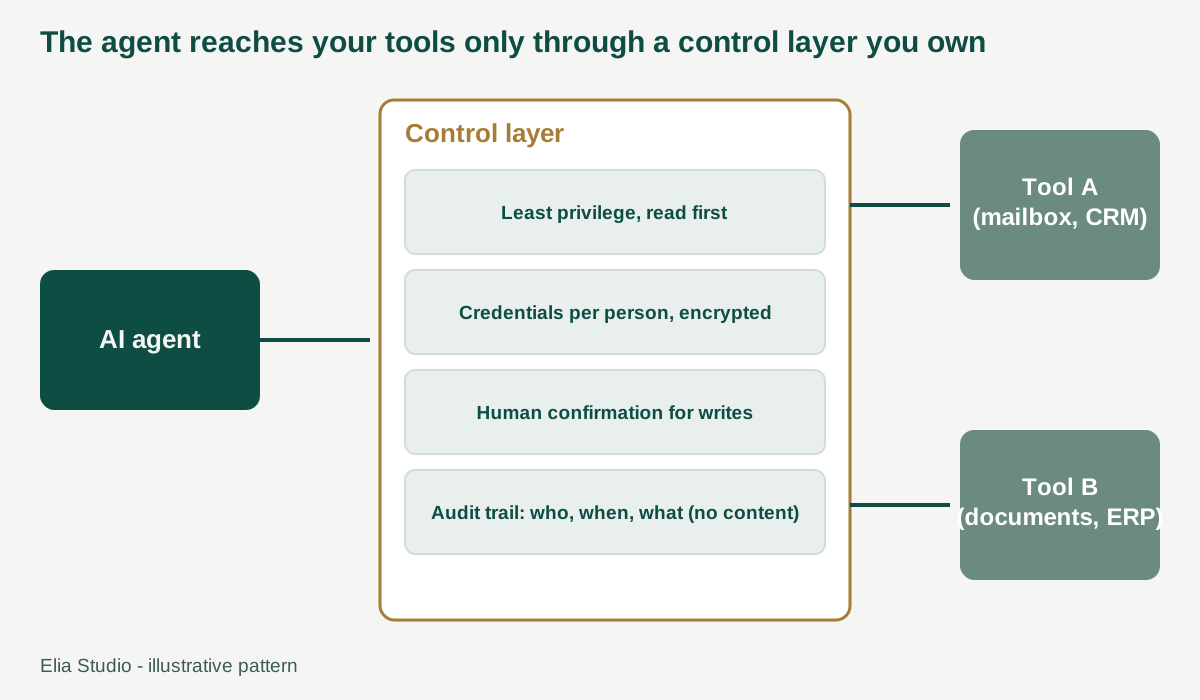
The protocol side is moving fast, but the principle stays the same. The MCP specification itself puts user consent and control first, and leaves the implementation of those controls to you. For the security risks of agents with too much power, see the OWASP Top 10 for LLM applications.
A worked example: mailbox connectors
We connected two mailboxes (Gmail and Infomaniak) to Nemrut, our open-core agent platform used by a company of about 250 people, through the Model Context Protocol. The pilot is administrator-only and read-only. The lesson: the connector was the easy part, and the control layer around it took the design effort. The detail is in AI agent email access: 7 questions to ask your AI expert.
Common failure modes
- Demo-driven scope: the agent impresses on sample data and fails on real documents.
- No owner: nobody is accountable after the project team leaves.
- Security as an afterthought: broad permissions granted “to make it work”.
- No evaluation: quality is judged by impressions, so regressions go unnoticed.
- Surprise bills: usage grows and cost per task was never measured.
- No adoption plan: the tool works and nobody uses it.
Questions to ask your AI expert
- What exactly changes between this demo and production?
- Who will own it in six months?
- How will we measure quality, and what threshold triggers go-live?
- What is the most the agent can do today, and who approves anything beyond reading?
- What will one task cost at ten times today's usage?
Go deeper
Before you move an agent to the next stage, run the AI agent production readiness checklist: 24 checks across six areas, 14 of them blockers, with a go/no-go rule.
For a risk-based approach to approvals, read Human-in-the-loop for AI agents: when to ask for approval. It explains which actions need review, how to enforce the decision and how to reduce unnecessary interruptions.
Next step
Start with one real use case: a single team, a scoped agent, a clear owner. Our Tailored AI Agents offer builds scoped agents from EUR 5k, in as little as two weeks depending on scope. Contact Elia Studio to discuss yours.
Frequently asked questions
- What is the difference between a POC and a production AI agent?
- A POC proves feasibility on sample data. A production agent runs on real data with security, evaluation, an owner, a budget and trained users.
- How long does it take to move an AI agent to production?
- It depends on scope, data quality and security requirements. A scoped MVP can be built in weeks; reaching dependable production usually takes longer and should be planned in stages.
- Do we need to host AI agents in Europe?
- Not always, but your data rules decide. A control layer you own lets you choose per use case.