
Nemrut: our foundation for tailored AI
How Nemrut supports Elia Studio’s tailored AI solutions: adoption, customisation and deployment choices.
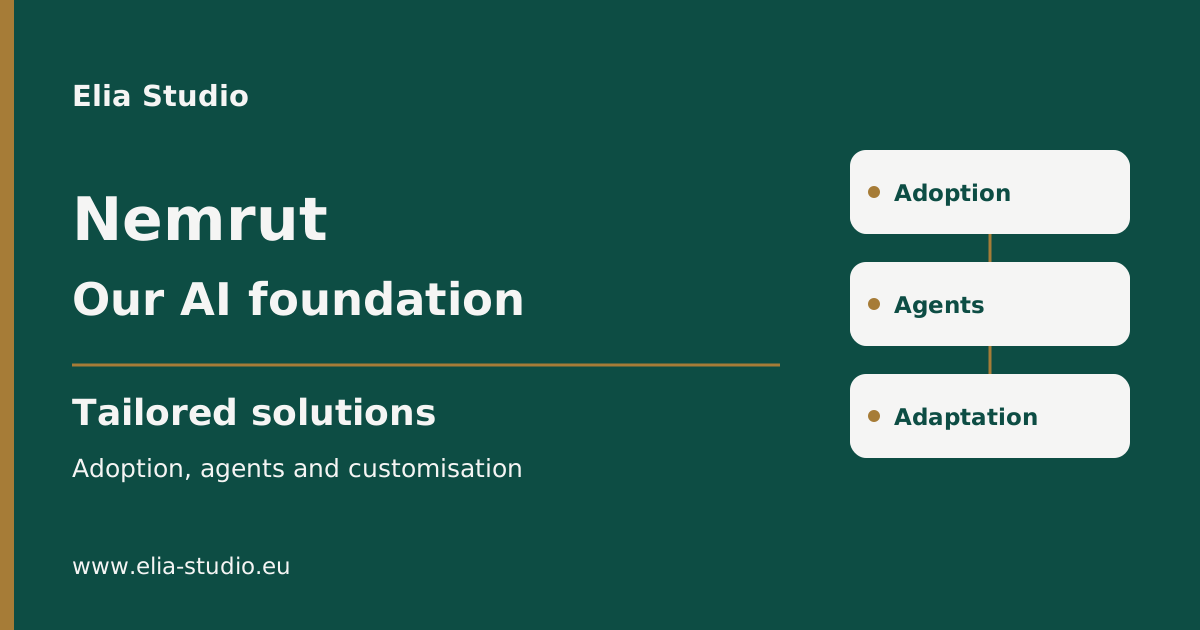
Nemrut is Elia Studio’s platform for supporting AI adoption and structuring implementations tailored to organisations. We use it as a working foundation, not an identical answer to every requirement. Each delivered solution is defined by its use case, data, users and agreed acceptance criteria, rather than a platform’s feature list alone.
Why use a shared foundation?
Tailored work does not require rewriting every element. Business needs differ; some components and methods can be reused when their boundaries fit the project.
Nemrut supports that approach. The intention is to concentrate customisation on the organisation’s rules, experience and information. No quantified delivery-time reduction is claimed here.
Definition: an implementation foundation is a reusable set of components and conventions used to build an appropriate solution, rather than impose one identical application on every team.
A workshop can share tools without producing identical objects. The request still needs understanding, materials need selection and the finished work needs inspection.
Elia Studio, Nemrut and Clin have different roles
| Element | Role |
|---|---|
| Elia Studio | Scoping and delivering tailored AI solutions |
| Nemrut | A foundation for selected implementations and adoption |
| Clin | A studio product for LinkedIn presence and outreach |
A platform, product and delivery service should not be treated as interchangeable. Clin addresses an identifiable workflow. Nemrut plays a more transversal role.
A platform’s purpose does not establish what a client receives. The proposal’s scope and commitments define actual deliverables.
Adoption starts with an understandable task
A chat interface does not explain a use case by itself. People need to know what to ask, which information is used and what requires checking.
Our approach connects implementation to those questions. What work does the tool prepare? Who examines it? When should the process return to a person? Text generation alone does not establish usefulness.
Adoption is not presented here as a measured outcome. It is a design objective to examine with users and accountable owners.
Give document agents explicit boundaries
A document assistant can retrieve passages and prepare an answer. Making that useful requires defining the collection, access rights, intended questions and situations requiring an explicit information gap.
Our RAG versus GraphRAG comparison connects retrieval choices to business questions. A technical choice does not replace an access rule or establish answer quality by itself.
We recommend visible references and tests for unanswerable questions. Confident wording is not evidence; people need to inspect what supports an answer.
Example: finding internal procedures
Consider a fictional team that wants to consult procedures and prepare internal responses. An initial implementation could cover an authorised collection, defined users and representative questions.
Some tests would examine conflicting or outdated procedures. Others would check that insufficient documentation does not produce an answer presented as certain.
If part of the collection is restricted to selected users, that constraint belongs in the design. It cannot be replaced by a prompt asking the model to respect confidentiality.
This example is neither a customer story nor a guarantee that every function is available in all configurations. It illustrates the work needed before choosing appropriate components.
Describe actual deployment and data choices
Nemrut should not be associated with a general promise that all data stays on disk. Storage, processing and services must be described for the intended deployment.
| Question | Decision to document |
|---|---|
| Storage | Where documents and derived information are retained |
| Processing | Which services receive request information |
| Access | Who can read and administer |
| Operations | Who maintains, observes and intervenes |
| Exit | What can be recovered and reconstructed |
Our sovereign AI guide examines these dimensions separately. A hosting label does not describe every flow in a system.
Licensing and commitments differ between products
Nemrut is described here as a proprietary platform used under contract with Elia Studio, following the current documentation reviewed by the studio. It is not presented as open source or open core.
Clin has a different status: its public code is available in alex-elia/clin. One product’s openness does not establish rights for another product.
For Nemrut, usage rights, deployment, maintenance and responsibilities need explicit commitments. A component’s presence in a foundation does not mean it is activated or included in every delivery.
What should a client evaluate?
Clients should evaluate the proposed solution against their work: relevant outputs, corrections, information access and the effort needed to use it.
They should also understand operating conditions. Who responds to errors? What happens after an update? Which changes require new approval? The POC-to-production roadmap provides a complementary framework.
The platform remains a means. The intended result is a team better equipped to do its work, with understandable responsibilities.
Begin with a useful scope
Our initial sprint from €5,000 includes development and delivery of a working agent MVP within an agreed scope. Nemrut can support an implementation where appropriate; using it is not a universal requirement.
Explore our services or contact Elia Studio. Understanding the need comes before choosing the foundation.
Frequently asked questions
- Is Nemrut open source?
- Current documentation describes Nemrut as a proprietary platform used under contract with Elia Studio. This article therefore does not call it open source or open core. Clin has a different status. Usage rights, deployment conditions and operating commitments should be specified in the proposal applicable to the intended implementation.
- Does Nemrut replace tailored delivery?
- No. A foundation does not establish business rules, authorised data, integrations and acceptance criteria by itself. An implementation needs scoping and adaptation. The platform can help structure that work when appropriate, without guaranteeing the same answer for every situation, organisation or team. Actual commitments belong in the project proposal.
- Does all data stay local?
- No general promise is made. Storage locations, processing and supporting services must be described for the intended deployment. Database location does not describe every flow. The selected models and enabled features influence what is sent and to whom. Review those choices rather than infer them from the platform name.
- How does it relate to the €5,000 sprint?
- The sprint from €5,000 includes development and delivery of a working agent MVP within an agreed scope. Nemrut may support the implementation when appropriate. Deliverables, rights and operating commitments remain defined by the proposal, not by a general component list. The platform is a means rather than the contracted outcome.
Read next
· 6 min read
Clin and Nemrut: two products, distinct roles
Clin for LinkedIn, Nemrut as a foundation for tailored AI: understand their roles, licensing and the move to an enterprise use case.
Read article →
· 8 min read
Clin: our open-source AI assistant for LinkedIn
Built by Elia Studio, Clin connects LinkedIn content and outreach. Choose your AI models and explore a tailored enterprise implementation.
Read article →
· 5 min read
AI agents in production: from POC to a system you run
What changes between an AI agent demo and a production system: data, security, evaluation, ownership, cost and adoption. A practical guide.
Read article →