
Sofinco: framing AI investment for finance teams
A finance AI roadmap engagement: connect business processes, estimated value and system dependencies to prioritise implementation.
A finance department needs more than another list of AI ideas: it needs to know where to invest, what must be in place and what should happen first. During an engagement with Sofinco, Alexandre Gon, founder of Elia Studio, connected Finance, Performance Management and Operations needs with automation opportunities and information-system dependencies to produce an actionable AI roadmap.
A banking reference with a defined scope
Sofinco is the consumer finance brand of Crédit Agricole Personal Finance & Mobility in France. That relationship provides context; it does not imply that the engagement covered the entire Crédit Agricole group. Official company publication, reviewed 4 November 2026.
The work concerned accounting, management control and operational performance management. Alexandre Gon delivered the engagement through an arrangement involving a partner consultancy and an intermediary. It is not presented as a direct contract between Elia Studio and the Crédit Agricole group.
The objective was to identify processes that could benefit from AI or automation and define a path consistent with an ongoing data and reporting transformation.
Turn ideas into investment choices
Manual checks, reconciliations, document processing and data consolidation can suggest many improvement opportunities. An attractive use case alone does not establish which one should start first.
Two apparently similar ideas can represent very different implementations. One may rely on a bounded process and available information. Another may depend on changing tools, data outside the team’s full control or substantial integration.
Definition: a technical-economic AI roadmap connects business opportunities to potential impact, feasibility, dependencies and implementation effort.
The purpose of scoping is to make those differences explicit and useful for decision-making. The objective is not the longest list of use cases, but a better basis for prioritisation.
Understand the work before selecting a solution
The engagement included interviews and analysis of processes, pain points and supplied documents. It required understanding where work occurred and how control and reporting tasks fitted the existing tools.
This avoids labelling every need as an AI-agent project. Some opportunities concern assistance with analysis or writing. Others call for conventional automation, a data prerequisite or a process change.
Elia Studio’s contribution is to connect actual work with appropriate technical possibilities. An impressive technology should not become the answer before the problem has been qualified.
Work with the information-system trajectory
The teams operated within an extensive application environment, with dependencies on group systems. Data and reporting modernisation was a defining constraint, not a detail to resolve after selecting projects.
The audited teams did not fully control incoming data quality, and AI maturity varied. Opportunities therefore needed to be assessed alongside their prerequisites rather than treated as immediately ready for implementation.
Planning AI in this situation resembles equipping a building already being renovated. Understanding the main works matters if the proposed improvement is to fit the eventual destination.
Our POC-to-production guide develops the distinction between a demonstration and an integrated solution. This engagement addressed audit and scoping, not completed industrialisation.
Connect potential value to implementation conditions
Opportunities were structured with estimates of impact, complexity and effort. The work distinguished near-term candidates from projects requiring deeper systems integration.
| Dimension | Decision question |
|---|---|
| Business relevance | Which work should improve? |
| Potential benefit | What can be estimated, and under which assumptions? |
| Feasibility | Which data, rules and capabilities are needed? |
| Dependencies | Which tools or transformations condition delivery? |
| Effort | What needs building to obtain a useful initial result? |
| Sequencing | What can start and what needs preparation? |
This framework summarises the scoping logic. It does not reproduce internal scores or estimates. The diagram below is an editorial reconstruction of the method, not a client deliverable.
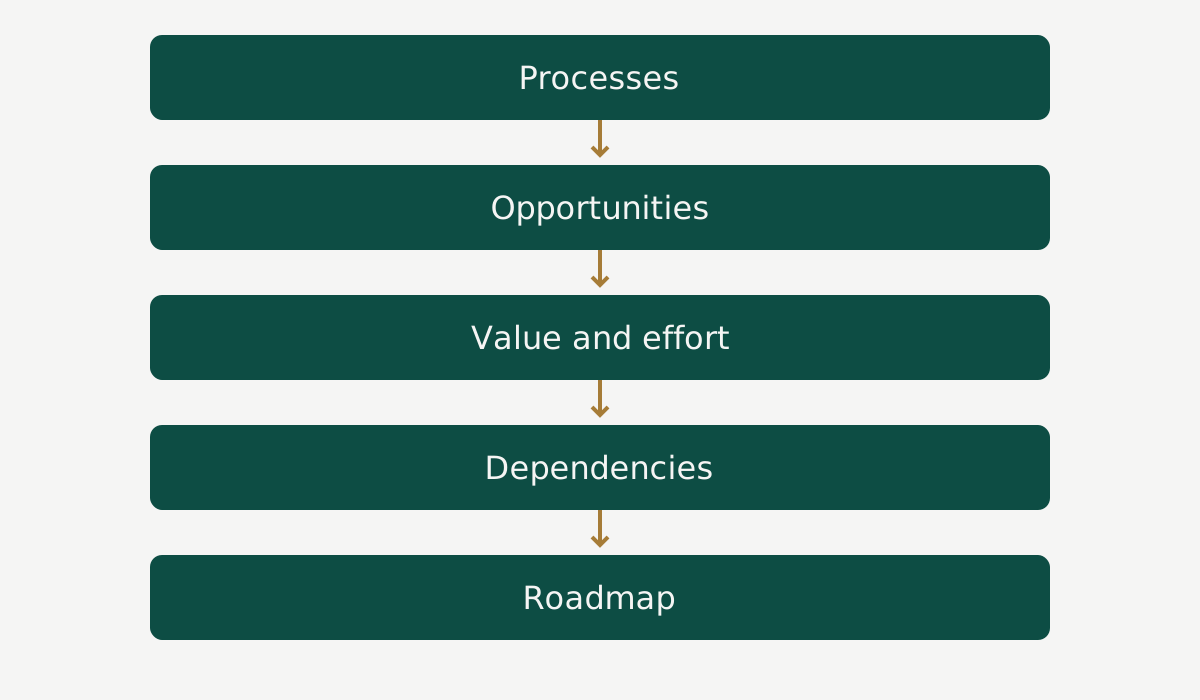
Illustrative method: no accounting rules, internal estimates or client architecture are reproduced.
The outcome: a documented portfolio and decision path
Audit deliverables were produced and presented, then revised using feedback from the partner consultancy and business contacts. The observable output is an opportunity map and roadmap to inform investment discussions.
This is more than an introductory presentation. It connects the subjects examined with their potential and implementation conditions, providing a structure for discussion between business needs and technical feasibility.
| Established by the project brief | Not claimed |
|---|---|
| Interviews and process analysis | An agent deployed in production |
| Opportunity mapping and prioritisation | A data migration personally put into production |
| Estimates of impact and effort | Realised productivity gains |
| Presentations and deliverable revisions | Approved investment decisions or budgets |
Numbers remain estimates of potential. This article does not turn them into operating results that the available account cannot establish.
Example: assessing a recurring check
Consider an illustrative scenario that does not reproduce a Sofinco process. A team wants to reduce work associated with a manual check.
Scoping examines inputs, rule stability, exceptions and planned tool changes. It may lead to consideration of deterministic automation, assistance with exception analysis or an initial data-quality task.
The right decision is not necessarily the one using the most sophisticated model. It is the option connected to the intended outcome and explicit delivery conditions.
After implementation, estimates need to be tested against actual accepted outputs, correction effort and operating costs. An audit prepares that measurement conversation; it cannot establish the result of a project that has not been delivered.
Our contribution: connect finance, data and investment
Business analysis identifies the work and its pain points. Technical analysis examines information, systems and dependencies. Economic analysis relates expected benefit to the effort required.
Combining those perspectives distinguishes an interesting idea from a project prepared for serious consideration. It can also reveal why an apparently straightforward automation requires a prerequisite outside the audited team’s immediate control.
That understanding is useful without pretending it eliminates all uncertainty. It supports better questions about integration, operations, evaluation and the conditions for a first implementation. Our AI automation ROI guide provides a complementary perspective on measuring subsequent results.
This case relies on the brief and clarifications supplied by Alexandre Gon. Public sources establish Sofinco’s corporate context, not the existence or outcomes of the engagement. No employee quotation or confidential document is published.
Begin with an opportunity portfolio
A finance department can start with selected priority processes, known pain points and its information-system trajectory. Elia Studio helps structure opportunities and prerequisites into a roadmap that can support delivery decisions.
Implementation follows within an agreed scope. Our sprint from €5,000 includes development and delivery of a working agent MVP. That offer is separate from this audit engagement and does not disclose its price.
Explore our AI audit and roadmap services or contact Elia Studio to connect business needs with the next implementation decisions.
Frequently asked questions
- What did the Sofinco engagement deliver?
- It produced an opportunity map and roadmap, presented and revised following feedback from the teams involved. Those deliverables formalised a portfolio of opportunities and a path to inform decisions. The available account establishes audit outputs, not realised productivity improvements, deployed software or an approved investment budget resulting from that work.
- Was a data migration or AI agent deployed?
- No such delivery is claimed here. The engagement examined opportunities and dependencies during a data transformation. Technical subjects remain opportunities studied, not developments personally deployed to production. Audit and implementation are distinct scopes, and a roadmap does not establish that any subsequent project was completed, released or adopted by users.
- Why not start by building an AI agent?
- An agent may be relevant, but a need may instead call for deterministic automation or a data prerequisite. Scoping distinguishes those situations. It connects the intended outcome to available information, rules and systems before committing development effort, rather than assuming the technology in advance or treating every problem as generative AI.
- Is estimated potential a guaranteed saving?
- No. An estimate depends on assumptions about processes, volumes, quality and implementation effort. It helps compare and prioritise. Realised savings require measurement after implementation within a defined scope and period, using an explicit method rather than automatically attributing every change to AI or presenting audit estimates as completed operating results.
Read next
· 6 min read
AI adoption: nemrut-core for engineering teams
A tailored business assistant on nemrut-core: editable Word proposals, human approval and practical AI adoption for engineering teams.
Read article →
· 6 min read
Sovereign AI: avoid premature infrastructure spending
Size sovereign AI for a mid-sized organisation: requirements, usage-based inference, dedicated capacity and review conditions.
Read article →
· 5 min read
AI contracts: mastering consumption commitments
Usage-based AI APIs can hide a fixed financial commitment. The clauses to examine and the scenarios to simulate before signing a generative AI contract.
Read article →