
Claude Code or Codex: build yourself or delegate?
Build with Claude Code or Codex, or commission an Elia Studio MVP? Compare time, skills, responsibilities and complete cost.
Claude Code or Codex can suit a team that wants to build and has the time and skills to direct the work. Delegating a sprint to Elia Studio addresses a different need: having a working agent MVP developed and delivered within an agreed scope, without transferring the whole implementation workload to the business team.
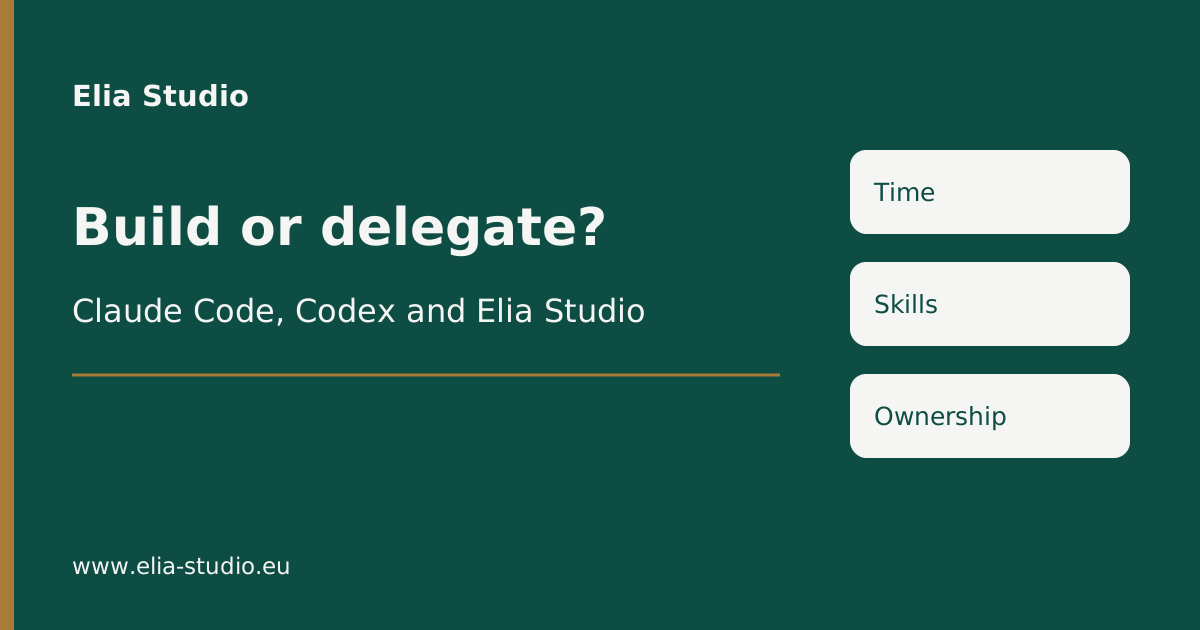
This is not a contest between a studio and software
Comparing Elia Studio directly with a coding tool combines two different categories. A tool helps perform development tasks. A delivery engagement defines work to hand over and the responsibilities around it.
Anthropic describes Claude Code as able to read a codebase, change files and run commands, including tasks involving tests and fixes. Claude Code documentation, reviewed 30 October 2026.
OpenAI explains that Codex can help test, check and review work when given clear criteria and appropriate checks. Treating it as a text generator alone would be inaccurate. Codex best practices, reviewed 30 October 2026.
The useful choice is organisational: who wants to own delivery, with which resources and responsibilities?
Define what building yourself means
Working definition: building yourself means retaining direction of the implementation, even when AI produces substantial parts of the code, tests and fixes.
A team can delegate many tasks to a tool while keeping decisions about needs, data, permissions and acceptance. Handwritten code volume is not the only measure of work remaining.
Think of a well-equipped workshop. Machine capability matters, but someone still needs to define the object and verify its suitability. This analogy does not establish the autonomy of any particular product; it separates technical capability from delivery responsibility.
Before starting, name the person who resolves ambiguity and the person who can continue after the first demonstration. If those roles are available, internal delivery deserves serious consideration.
A decision framework for your team
This is our proposed comparison, not a model benchmark or universal recommendation to outsource.
| Question | Internal AI-assisted delivery | A studio sprint |
|---|---|---|
| Who directs it? | An available internal owner | An agreed scope and named contacts |
| Who verifies it? | The team organises checks | Proposal defines criteria and acceptance |
| Who integrates it? | The team builds and checks connections | Selected integrations are agreed explicitly |
| Who operates it? | An internal owner needs identifying | Ownership still needs specifying; it is not implicit |
| What cost matters? | Tools, time, infrastructure and rework | Delivery fee, client participation and operations |
The answer may be internal, external or hybrid. The framework makes the choice explicit rather than assuming every project needs a studio.
When internal building makes sense
Internal delivery deserves examination when someone wants to own the product and has capacity to evolve it.
It can also let a technical team learn within its own context. The important distinction is that a subscription is not a complete budget, and a demonstration is not validation of the need.
OpenAI recommends requesting relevant tests, checks and review before accepting changes. That highlights the need to define an acceptable result even when the tool executes much of the loop. Codex best practices, reviewed 30 October 2026.
When delegation addresses a different need
Delegation deserves examination when a business team wants an implementation without owning all development activity. Its expertise remains essential to explain the work and judge the result.
At Elia Studio, the initial sprint from €5,000 includes development and delivery of a working agent MVP within an agreed scope. That does not promise every integration, one universal duration or indefinite operation.
Our AI sprint guide distinguishes a first working agent from broader production deployment. Commitments belong in the agreement; the word delegation does not define them by itself.
Example: preparing procedure-backed responses
Imagine a team consulting procedures to prepare internal responses. This is a fictional scenario, not a client story or price estimate.
For an internal build, someone can direct the coding agent, define the authorised collection and organise tests. That owner also needs to decide how to handle unanswerable questions and document changes.
For a delegated sprint, the team explains those situations and participates in evaluation. The studio implements the agreed boundary. Environment, access, expected references and any exclusion of automatic sending need to be explicit.
Compare both routes against the same result: useful, verifiable and appropriately bounded preparation. Do not compare a simple internal interface with an engagement that also includes additional integrations and controls.
Compare complete cost without inventing ROI
For internal work, include direction, review, integration and rework alongside subscriptions and usage. For external delivery, add business participation and operating costs to the delivery fee.
These are cost categories, not an estimate of your project. No universal saving or payback period is promised. Our AI automation ROI guide develops this approach.
A comparison should also make its assumptions visible. Using different documents, user groups or acceptance criteria can make apparently similar demonstrations answer different questions. Write down the boundary before interpreting cost differences.
Plan handover and operations
Before choosing, ask who will hold the rights, documentation and access needed after delivery. Specify how changes and incidents will be handled.
A working MVP does not automatically authorise every business use. The POC-to-production roadmap examines that stage separately. Coding tools and a studio are means towards an operable system, not substitutes for an operating decision.
An internal owner may want external help with one difficult integration rather than a whole implementation. Another team may prefer a complete bounded delivery and retain acceptance internally. Hybrid arrangements should name those boundaries rather than rely on an informal expectation that somebody else will handle the remaining work.
Choose what your team wants to own
Clin, a studio product, and Nemrut, our implementation foundation, play different roles. Nemrut is not presented here as a direct competitor to Claude Code or Codex.
If your team wants to build, coding tools merit evaluation. If it wants to stay focused on business work and delegate a bounded implementation, explore our tailored AI services or contact Elia Studio.
The decision is not a choice between people and tools. It is a choice about the work to deliver and the responsibilities you are ready to carry.
Frequently asked questions
- Can Claude Code and Codex build applications?
- Their documentation describes reading and changing code, running commands and helping with tests or reviews. Reducing them to snippet generation would be misleading. The useful question is who defines, verifies and operates the application in your context, and whether that person has the capacity to carry the work forward.
- Why delegate if coding tools can write the software?
- Delegation can address limited availability, skills or delivery capacity. It does not establish that the tools are unable to produce code. A provider’s scope should specify what it takes on and what remains with the client, including acceptance, access, operations and any support that has actually been agreed.
- What does Elia Studio’s sprint from €5,000 include?
- It includes development and delivery of a working agent MVP within an agreed scope, not only a workshop or mock-up. Integrations, acceptance criteria, handover and operating conditions need to be specified in the proposal. The starting price does not promise a universal timeline or company-wide production rollout for every use case.
- Can external delivery and AI coding tools be combined?
- Yes. Teams can delegate an initial implementation and later take over selected changes, or retain part of the development internally. Agree on rights, documentation, handover and ownership. No transfer arrangement is automatically included without agreement, and the chosen operating model should reflect the people who will maintain the solution.
Read next
· 5 min read
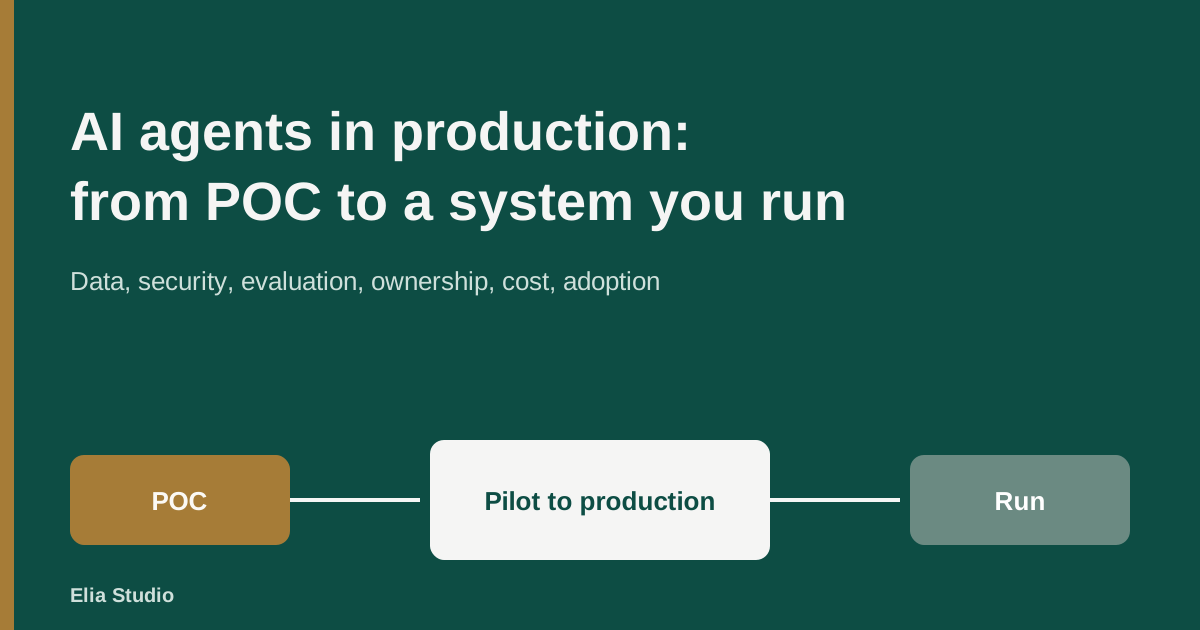
AI agents in production: from POC to a system you run
What changes between an AI agent demo and a production system: data, security, evaluation, ownership, cost and adoption. A practical guide.
Read article →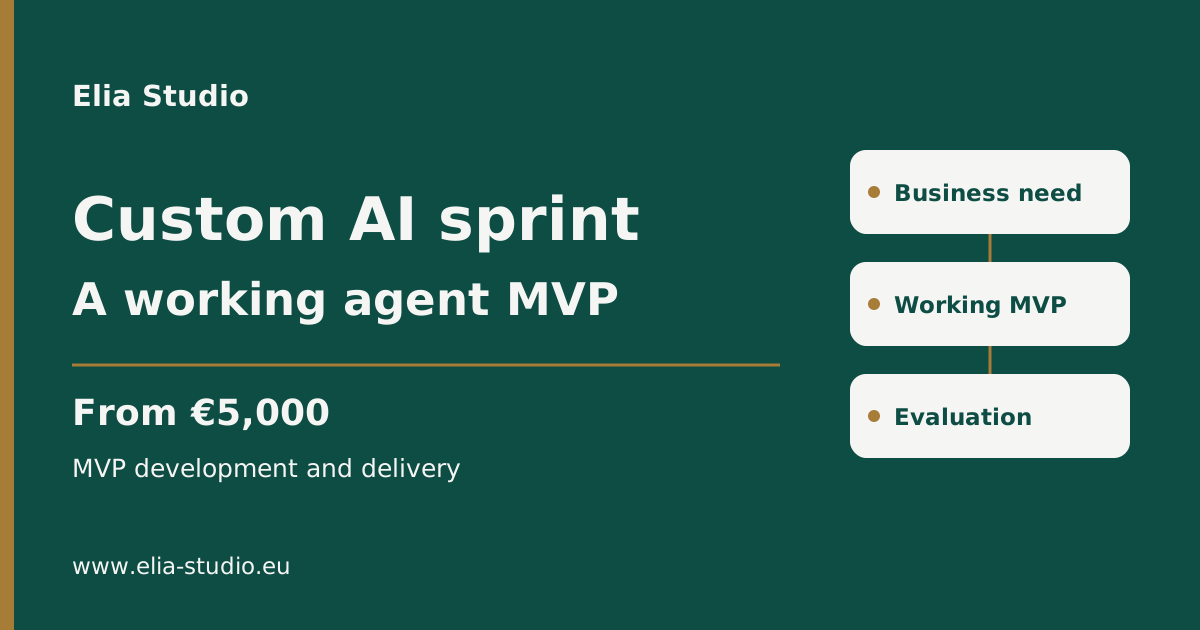
· 5 min read
AI sprint: a working agent MVP from €5,000
Development and delivery of a working agent MVP from €5,000: scope, evaluation and next steps with Elia Studio.
Read article →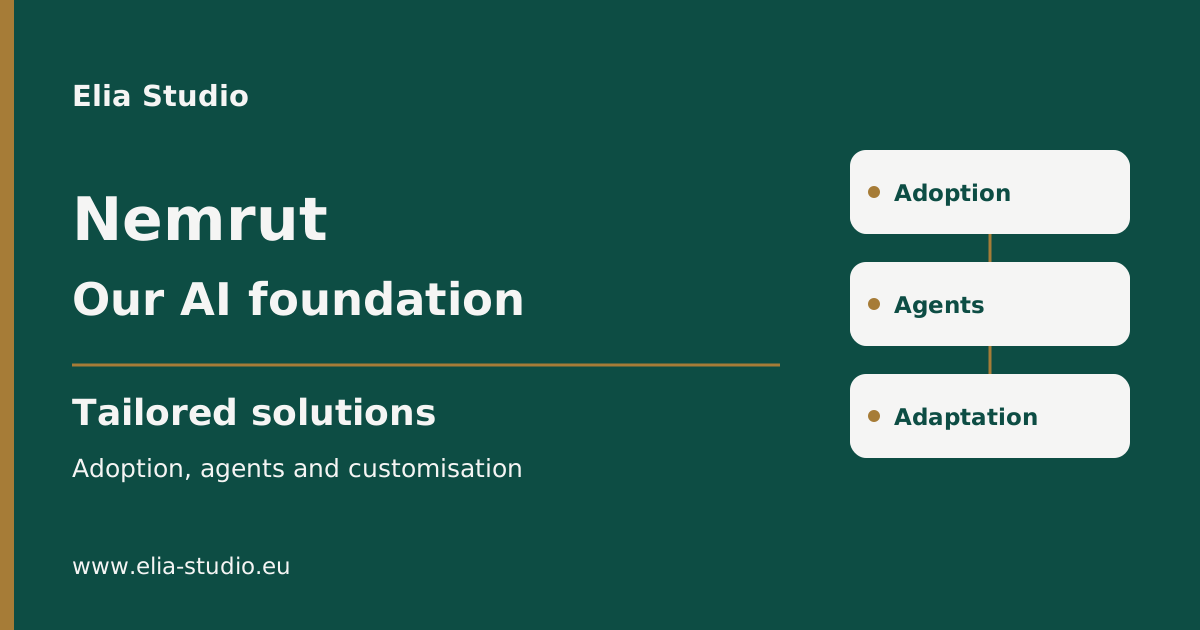
· 5 min read
Nemrut: our foundation for tailored AI
How Nemrut supports Elia Studio’s tailored AI solutions: adoption, customisation and deployment choices.
Read article →