
Enterprise AI agent architecture: security
Design a safer enterprise AI agent: permissions, data, tools, evaluation and full operating costs before production.
Short answer: enterprise AI agent architecture separates the model, data, tools and execution. Permissions are enforced outside the model, with least privilege, parameter validation and approval for sensitive actions. Production also requires representative evaluations, an accountable owner, supervision and execution budgets. Start with the authorised task, not the most autonomous framework available.
Definition: AI agent architecture. The organisation of a model, sources, tools and execution rules so that the system acts only within an authorised scope.
An agent that finds a contract does not create the same risk as one that edits or sends it. Yet both capabilities can share a chat interface. The first architecture decision should therefore be the scope of action, not the model.
Chatbot, workflow or agent: how much complexity?
| Need | Starting point | Watch point |
|---|---|---|
| Answer from documents | Assistant with retrieval | Access rights and sources |
| Execute known steps | Deterministic workflow with targeted AI | Errors and recovery |
| Choose steps from context | Agent with bounded tools | Authorisation and loop limits |
This is a design recommendation, not a regulatory classification. An agentic loop needs a measurable benefit: broader request coverage, fewer manual exceptions or shorter handling time. A stable rule does not need to be replaced by a model.
OWASP describes excessive agency as a risk created by too much functionality, permission or freedom of execution. It recommends narrow tools and downstream authorisation. OWASP: Excessive Agency
Which reference architecture should you use?
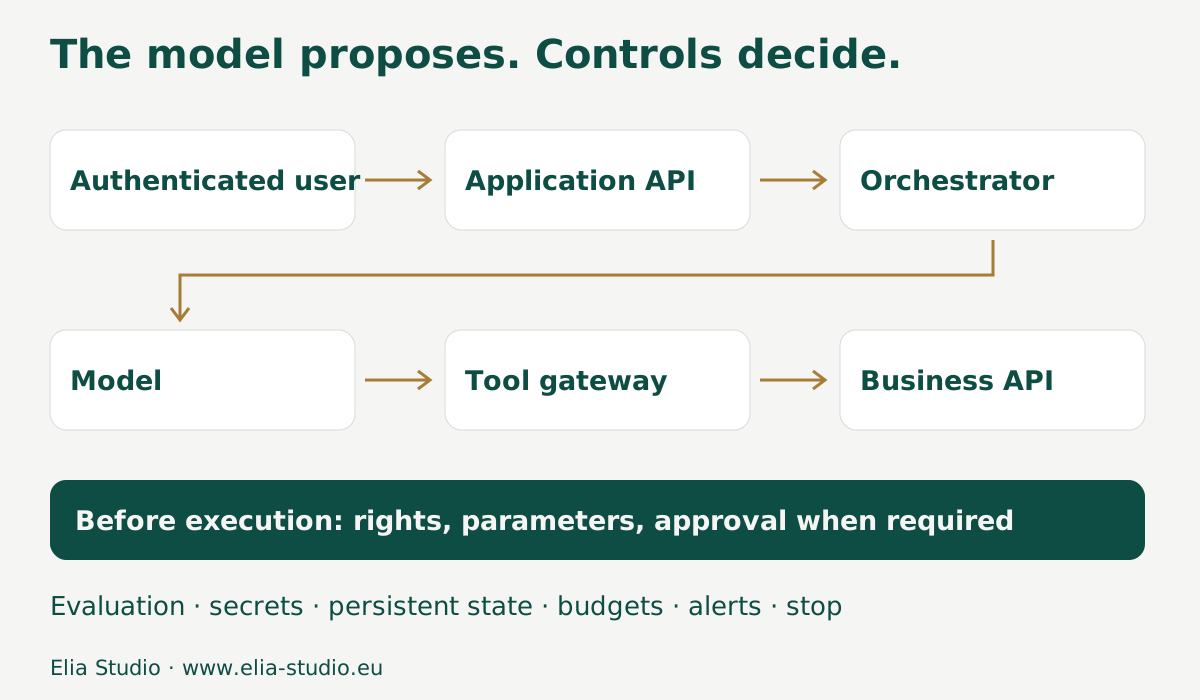
For an agent that prepares cases without committing the company, we propose the following path. It is an illustrative architecture, not a customer deployment claim.
Authenticated user
  -> Application API: identity, scope, budget
  -> Orchestrator: state and authorised steps
  -> Model: extraction, summary, proposal
  -> Tool gateway: schema, rights, parameters
  -> Human approval when required
  -> Business API: execution and result
The model proposes. Application code decides whether the proposal may run. The target system checks rights on the resource. Evaluation, secrets, persistent state, alerts and stopping are cross-cutting services.
Think of a colleague with a set of keys. Understanding a request does not grant permission to open every door. Controls must remain effective even when the colleague misreads a document.
Separate knowledge from action
Document retrieval and case updates should not automatically inherit the same permissions. Retrieval-augmented generation (RAG) does not replace access control. Filter sources by user before providing them to the model, then test cross-team access attempts.
Our RAG vs GraphRAG guide helps select a retrieval approach. That decision does not remove the need to authorise retrieved documents and derived information.
Give precise tools
Prefer create_draft(case_id, text) to general access that can send any message. A bounded status-update API is preferable to a SQL connection with broad write permissions when that narrow change is all the task requires.
How should permissions and approvals work?
| Action | Scope | Proposed control |
|---|---|---|
| Read a document | Assigned case | Check before retrieval |
| Summarise | Accessible sources | References and completeness |
| Create a draft | Current case | Schema checks and logging |
| Send a message | Identified recipient | Approve content and target |
| Modify a sensitive reference record | Outside initial scope | Block or separate authorised flow |
Approval should not cover only an intent such as “process the case”. Show the actual action, target and parameters. If content or recipient changes, the earlier approval is no longer sufficient. OWASP includes action-specific approval for consequential operations. OWASP: Prompt Injection Prevention
An interruption must not create a second send. Use persistent execution state and idempotency keys to recognise operations already performed. See our guide to human approval for AI agents.
How do you limit injection and data leaks?
A retrieved document may contain malicious instructions. Indirect prompt injection tries to turn those data into commands. A filter alone is not enough: tools must enforce permissions independently of the model's response. OWASP: Prompt Injection Prevention
- Treat external inputs as untrusted.
- Separate application instructions from documents.
- Validate tool arguments.
- Restrict resources and network destinations.
- Approve sensitive operations before execution.
- Test attacks in attachments, searches and API responses.
Logs should support operations without copying every document. Case identifiers, model versions, tool names and authorisation decisions may be sufficient, depending on the need. Exclude secrets and unnecessary sensitive content, and protect the traces themselves.
How do you assess quality and cost?
A model benchmark does not validate the complete system. Evaluate normal, incomplete, contradictory and adversarial cases against criteria set before the pilot.
| Dimension | Proposed measure |
|---|---|
| Business quality | Cases accepted after review |
| Document reliability | Statements tied to evidence |
| Security | Forbidden actions blocked |
| Operations | Failures, delays and retries |
| FinOps | Full cost per accepted case |
Good writing does not offset forbidden access. Full cost includes models, retrieval, tools, infrastructure, human review and support. Also limit steps, duration, retries and spend per task. Exceeding a budget should cause a controlled stop or escalation.
Keep tool schemas, tests and policies outside the model provider. A model change remains an evaluation project, but need not become a complete workflow rebuild. See evaluating an AI agent before launch.
What should you check before production?
- A business owner and technical owner are named.
- Authorised data and actions are documented.
- Rights are enforced outside the model and tested.
- Approvals, duplicates and interruptions are handled.
- Budgets, alerts and loop limits are active.
- Stopping and degraded operation have been tested.
- Model changes trigger a new evaluation.
The CNIL, France's data protection authority, recommends effective, lasting means of human intervention, including changing a decision or stopping a system where necessary. CNIL: Using AI in production, in French
Complete the review with the production readiness checklist and the POC-to-production roadmap.
Frame an operable agent
Elia Studio builds tailored AI agents, runs opportunity audits and designs sovereign roadmaps. Start with a scope decision: which tasks, data, permissions and evidence are required before production? Contact Elia Studio to frame it.
Sources reviewed on 28 October 2026. Architecture and matrices are illustrative; no customer results are claimed.
Frequently asked questions
- Should an AI agent have the same rights as the user?
- Not automatically. Its rights should match the authorised task and never exceed what the user may delegate. A bounded service identity can suit a narrow process; delegated user rights may preserve individual restrictions. Check authorisation on each target resource as well as at the application boundary.
- Is a system prompt enough to secure an agent?
- No. A prompt can describe rules, but it is not the mechanism that grants or refuses execution. Authorisation, parameter validation and action limits must be enforced by code and target services. Test forbidden actions directly, including requests carried by retrieved documents and tool responses.
- Does every action need a human?
- We recommend matching control to risk: automate bounded, reversible operations after evaluation, and approve sensitive operations before execution. Legal and sector rules may add requirements. An approval does not replace technical controls, error handling or a reliable way to recover when the workflow is interrupted.
- How do you know whether an agent is cost-effective?
- Compare the process before and after deployment at comparable quality. Include checks, corrections and operations. Faster drafting is not enough if total handling time rises. Distinguish theoretical capacity freed, avoided expenditure and financial gains actually observed, and include difficult cases as well as routine ones.
Read next
· 6 min read
Claude Code or Codex: build yourself or delegate?
Build with Claude Code or Codex, or commission an Elia Studio MVP? Compare time, skills, responsibilities and complete cost.
Read article →
· 6 min read
Clin and Nemrut: two products, distinct roles
Clin for LinkedIn, Nemrut as a foundation for tailored AI: understand their roles, licensing and the move to an enterprise use case.
Read article →
· 8 min read
Clin: our open-source AI assistant for LinkedIn
Built by Elia Studio, Clin connects LinkedIn content and outreach. Choose your AI models and explore a tailored enterprise implementation.
Read article →